
Marketing Teams Face Three-Role Restructure as AI Search Citations Replace Traditional Rankings
Marketing organizations must restructure three core roles and reallocate 15% to 20% of quarterly budgets to capture visibility in AI-powered search platforms, according to a framework published August 31 by Search Engine Journal.
 Marcus Webb··5 min read
Marketing Teams Face Three-Role Restructure as AI Search Citations Replace Traditional Rankings
Marketing organizations must restructure three core roles and reallocate 15% to 20% of quarterly budgets to capture visibility in AI-powered search platforms, according to a framework published August 31 by Search Engine Journal. The restructure centers on converting SEO leads into AI search leads, shifting content teams from volume production to evidence generation, and moving digital PR from brand budgets into performance channels.
The restructure addresses a measurement gap in existing marketing organizations, according to the analysis. Teams maintaining traditional SEO retainers, content calendars, and paid search allocations lack ownership over whether AI platforms like ChatGPT, Perplexity, or Google's AI Mode cite their brands in generated answers. The framework targets marketing teams at venture-backed and private equity-owned companies with existing budgets north of $350,000 annually.
Three Role Changes Replace Traditional SEO Structure
The SEO lead role expands into an AI search lead position responsible for entity management across all platforms where large language models extract information, the framework states. The scope change shifts focus from ranking positions to citation frequency, requiring ownership of brand entity consistency across company websites, LinkedIn profiles, G2 listings, Crunchbase pages, Reddit discussions, and industry directories.
Entity fragmentation emerged as the most common audit finding, according to the analysis. Companies operating with multiple brand names, separate domains, and conflicting descriptions across properties present as weak entities to AI models rather than consolidated authorities. A single role owner can resolve entity fragmentation within one quarter through attention-intensive cleanup work requiring minimal budget investment.
Content teams reduce publishing volume by 50% and redirect labor hours toward producing quotable evidence, the framework recommends. Priority shifts to original data releases, customer outcome documentation with specific metrics, expert commentary from internal subject-matter experts, and page structures enabling clean answer extraction. Eight generic monthly posts deliver less AI citation value than one data-backed piece containing proprietary statistics.
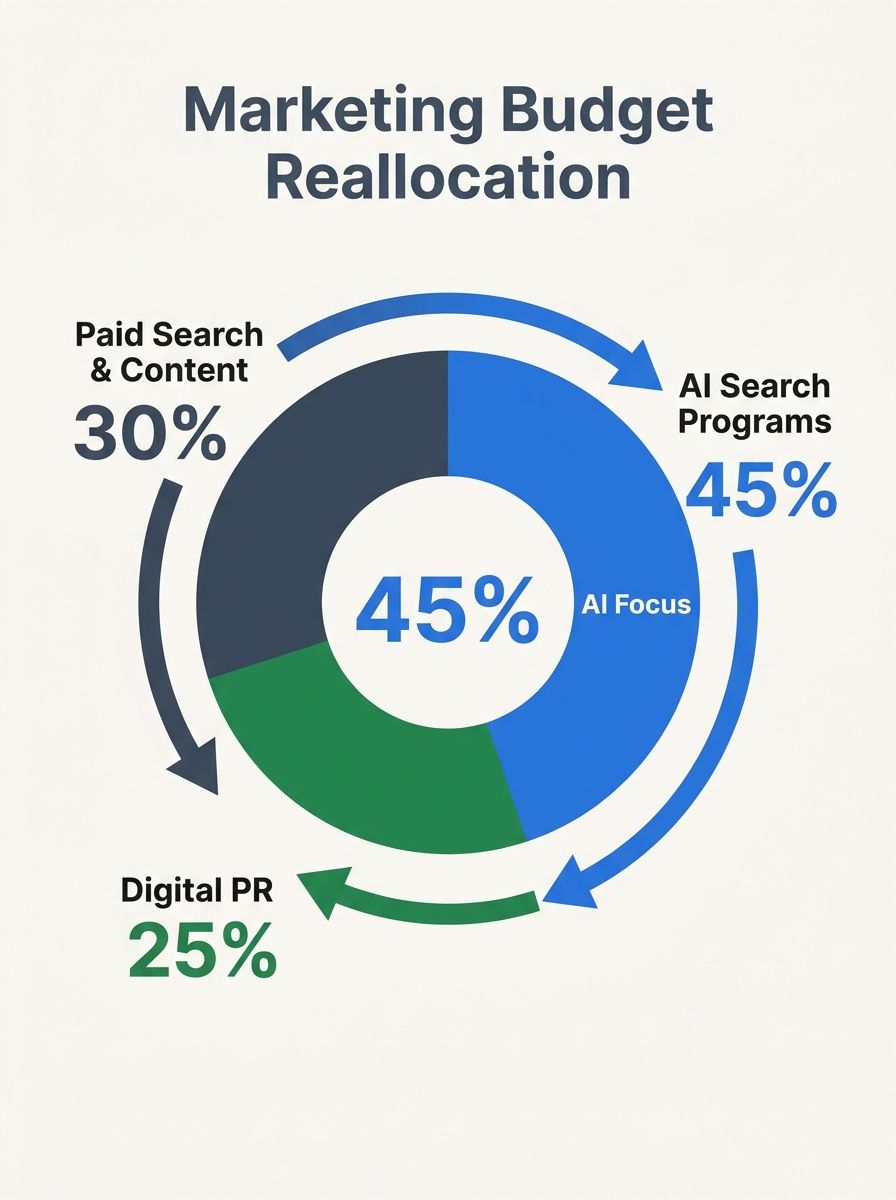
Digital PR functions move from brand budget lines into performance marketing allocations with quarterly citation targets, according to the restructure model. AI models weight agreement across independent third-party sources when generating answers, making trade publication mentions, review platform presence, and community discussions function similarly to how backlinks operated in traditional search ranking algorithms a decade ago.
Budget Reallocation Follows 90-Day Testing Sequence
A sample $60,000 monthly marketing budget restructure reduces paid search spending from $30,000 to $24,000 while maintaining brand term protection and converting non-brand campaigns, the framework shows. Content production budgets drop from $12,000 to $10,000 monthly as teams produce fewer pieces with deeper proof backing each publication.
The restructured allocation directs $10,000 monthly toward AI search program operations covering entity cleanup, structured data implementation, and citation measurement. Digital PR receives $10,000 in monthly funding tied to citation performance targets rather than brand awareness metrics. Tool budgets increase from $5,000 to $6,000 monthly to add AI visibility tracking platforms alongside existing SEO software suites.
Paid search budgets should decline only 20% in initial restructures because paid campaign query data reveals which searches carry buying intent, the analysis states. Those high-intent queries become the test set for measuring AI platform citation performance, making complete paid program defunding counterproductive to AI search optimization measurement.
The framework recommends moving 15% to 20% of total budget during the first quarter implementation, then allowing citation measurement data to guide subsequent reallocation decisions. Organizations should avoid reorganizing all marketing functions simultaneously or defunding working paid programs based solely on strategic projections.
Implementation Sequence Measures Before Restructuring
The 90-day implementation sequence begins with four weeks of baseline citation measurement, according to the framework. Marketing teams test their 20 highest-intent buyer queries across four major AI assistants—ChatGPT, Gemini, Perplexity, and Google AI Mode—recording every generated answer, citation source, and competitor mention. Teams simultaneously fix entity fragmentation issues while establishing baseline metrics.
A Series B software company entering the restructure process held 14 page-one keyword rankings but appeared in only four of 20 AI-generated answers when tested across major platforms, the framework cites as a typical audit finding. The disconnect between traditional ranking performance and AI citation frequency demonstrates why existing SEO work fails to generate visibility in AI-mediated search experiences, according to the analysis.
Teams running the baseline phase should use AI visibility tracking tools including Peec AI for citation monitoring or Semrush's AI toolkit for consolidated platform coverage, the framework suggests. The baseline measurement phase costs minimal budget while establishing quantitative evidence for subsequent reallocation decisions.
Weeks five through eight focus on controlled experiments testing which content formats, entity signals, and third-party placements generate citation lifts. The final month scales proven tactics while maintaining measurement continuity to justify ongoing budget shifts beyond the initial 90-day cycle.
Organizational Reporting Structure Determines Success Rate
AI search program ownership should report directly to demand generation leaders in marketing teams under 20 people, the framework states. Larger organizations should assign AI search oversight to the vice president of marketing personally until the function proves revenue impact, because new functions reporting three organizational layers below executive leadership face rapid deprioritization.
The allocation model addresses annual planning cycles that lock budget decisions for 12-month periods based on fourth-quarter strategic reviews, according to the analysis. Marketing leaders conducting 2027 planning in fourth quarter 2026 should incorporate the restructure framework rather than waiting for next year's offsite planning sessions, because AI search platforms continue layering atop traditional Google search rather than replacing it entirely.
Teams grading content production on output volume metrics should shift performance measurement to citations earned and pipeline influence, the framework recommends. The scoring change supports the volume-to-evidence transition by aligning individual contributor incentives with business outcomes rather than activity metrics.
Reading Between the Lines
The $60,000 monthly budget example and three-role restructure model provide CMOs with a defensible framework for reallocating resources without wholesale team replacement or speculative new hiring. The 90-day baseline measurement phase addresses the executive reluctance to defund working programs based on trend predictions rather than quantitative evidence. Digital marketing agencies serving mid-market and enterprise clients should expect restructure conversations in Q4 2026 planning cycles as organizations prepare 2027 budgets.
The entity fragmentation finding—companies with page-one rankings appearing in fewer than 25% of AI answers—quantifies the visibility gap between traditional SEO performance and AI platform citation rates. Marketing leaders holding the 2022 allocation model while buyer search behavior shifts toward AI-mediated discovery face compounding opportunity cost as more purchase research happens in platforms outside traditional Google search results pages.
The framework's emphasis on moving digital PR into performance marketing with quarterly citation targets rather than brand awareness metrics creates measurable accountability for a historically soft budget line. Organizations cutting PR spending during economic downturns should revisit that prioritization logic as AI models collapse regional SEO authority signals into single global entity representations requiring third-party validation across independent sources.
Marcus Webb
Digital marketing consultant and agency review specialist. With 12 years in the SEO industry, Marcus has worked with agencies of all sizes and brings an insider perspective to agency evaluations and selection strategies.
Related Articles

Google Marketing Live 2026 Confirms End of Traditional Search as Agency Study Shows Top-Ranked Brands Invisible to AI 69% of Time
Google announced at Marketing Live 2026 that traditional search has ended and all search on the platform now operates through AI-based systems, according to NP Digital's APAC managing director Dan Kalinski writing in Marketing-Interactive. The announcement validates what an NP Digital experiment mea

Search Engine Journal Identifies Five AI Search Shifts Requiring Immediate Strategy Adjustments Before Q3
Search Engine Journal identified five AI-driven changes to search engine results pages that require immediate strategy adjustments before third-quarter planning cycles close, according to analysis published June 11. The shifts, spanning organic click-through rate decline, AI Overview citation mechan

Search Engine Journal Publishes Three-Part Integrated Brief Framework to Unify SEO, PPC, and Content Strategy in AI Search Era
Search teams operating from separate priorities cost B2B firms qualified leads and budget efficiency even when targeting identical audiences, according to a planning framework published by Search Engine Journal on June 17, 2026. The three-section integrated search brief addresses siloed execution pa
Explore more topics