
Most Websites Fail Two Critical AI Search Optimization Layers Despite Basic Retrievability Gains, 50-Site Audit Finds
Nearly two-thirds of major websites leave artificial intelligence bot access protocols undefined while almost none implement structured attribution signals that enable AI systems to correctly interpret content meaning, according to a three-layer audit framework published September 1 by Search Engine
 Marcus Webb··3 min read
Most Websites Fail Two Critical AI Search Optimization Layers Despite Basic Retrievability Gains, 50-Site Audit Finds
Nearly two-thirds of major websites leave artificial intelligence bot access protocols undefined while almost none implement structured attribution signals that enable AI systems to correctly interpret content meaning, according to a three-layer audit framework published September 1 by Search Engine Journal. The audit of 50 websites across retail, SaaS, travel, publishing, and finance sectors found organizations have optimized for AI retrievability but largely ignore comprehension and transactional capability layers.
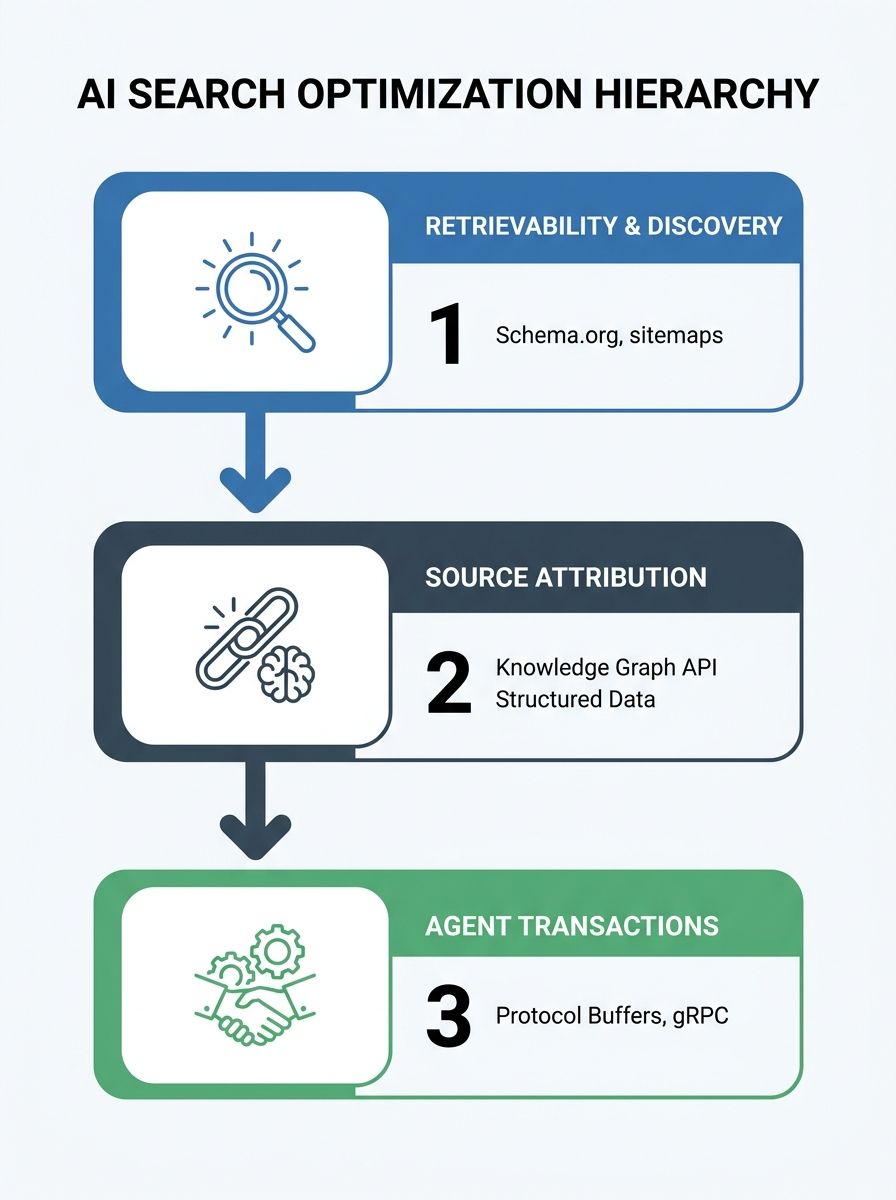
The framework divides AI search readiness into three distinct technical layers rather than treating visibility as a single optimization target, according to the published methodology. Layer One covers retrievability, whether AI platforms can fetch and parse content without technical barriers. Layer Two addresses attribution and meaning through structured data implementations that clarify product prices, author authority, and entity disambiguation. Layer Three encompasses agent transaction and discovery protocols enabling AI systems to complete tasks such as purchases on behalf of users.
Most audited sites implemented Layer One protocols including clean code architecture and content chunking that facilitate AI crawling. The audit found widespread failures in Layers Two and Three, with organizations leaving machine interpretation of content attributes to probabilistic guessing rather than explicit markup.
Attribution Gap Increases Misrepresentation Risk
The audit framework identified 27 technical elements across the three layers, 11 elements in Layer One retrievability, three in Layer Two attribution, and 13 in Layer Three agent capability. Each element received a maturity classification: established standards in production use, emerging protocols gaining adoption among early implementers, or frontier standards still under debate.
Layer Two attribution protocols determine how AI systems identify which numbers represent product prices versus loyalty-card discounts, confirm brand and author identity for authority assessment, and disambiguate entities sharing names across different categories. The absence of these signals forces AI platforms to infer meaning from context alone, according to the framework documentation.
Organizations implementing JSON-LD schema markup and entity mapping reduce the likelihood of AI-generated responses misrepresenting their brand claims or product specifications. The audit found implementation rates for these protocols significantly lagged behind basic retrievability optimizations.
Bot Access Control Remains Unmanaged
The finding that nearly two-thirds of audited websites lack defined AI user-agent directives in robots.txt files indicates organizations have not determined which AI platforms should access which content sections. This technical gap affects both citation likelihood in AI-generated responses and control over how proprietary content gets incorporated into training datasets.
Layer Three agent transaction protocols address whether AI assistants can interact with website functionality to complete user-delegated tasks. The audit examined 13 elements including transactional API availability, authentication protocols for agent access, and structured endpoints enabling AI systems to execute purchases or bookings. Implementation of these protocols remains sparse across the audited cohort.
The framework applies uniform scoring across industries despite different business models requiring different optimization priorities. A website serving primarily informational content requires different Layer Three implementations than an e-commerce platform where transaction capability directly affects revenue, according to the methodology notes.
Organizations evaluating AI search optimization frameworks face technical implementation decisions beyond the citation-focused visibility strategies that dominated 2024 and 2025 discussions. The three-layer model distinguishes between AI systems reading content, correctly interpreting that content's meaning and ownership, and executing tasks based on that interpretation.
Context and Outlook
The audit results indicate that SEO teams have prioritized the technical signals most familiar from traditional search optimization, crawlability, rendering, and text accessibility, while overlooking the structured data layer that determines how AI platforms assign meaning to retrieved content. This gap matters as AI search systems shift cognitive work from query formation to post-synthesis verification, making accurate source interpretation more critical than raw retrievability.
The maturity classifications assigned to framework elements suggest near-term optimization priorities. Established protocols including JSON-LD schema and ARIA labeling require immediate implementation for organizations seeking reliable AI representation. Emerging standards such as entity mapping and AI user-agent directives represent tactical advantages for early adopters. Frontier elements including transactional agent protocols remain speculative but warrant monitoring as AI assistant capabilities expand beyond information retrieval into delegated task execution.
Marketing teams evaluating their current AI readiness should audit not just whether AI platforms cite their content, but whether those citations accurately represent product attributes, pricing structures, and authority claims. The distinction between reading and comprehension applies to AI systems as directly as to human users, retrievability establishes presence while attribution establishes accuracy.
Marcus Webb
Digital marketing consultant and agency review specialist. With 12 years in the SEO industry, Marcus has worked with agencies of all sizes and brings an insider perspective to agency evaluations and selection strategies.
Related Articles
Cloviana Publishes Comprehensive AI Search Optimization Framework as B2B Buyer Research Shifts to ChatGPT and AI Platforms
Cloviana published a comprehensive guide to AI search optimization on June 25, 2026, outlining how B2B brands can optimize for visibility in AI-generated answers across ChatGPT, Claude, Perplexity, Google AI Overviews, and Gemini as 71% of B2B buyers now rely on AI chatbots for software research, ac
Why AI Search Visibility Requires a Different SEO Checklist Than Google's Blue Links
Traditional SEO checklists produce passing grades on sites that are invisible to ChatGPT, Perplexity, and Google AI Overviews.

TrySight.ai Publishes Step-by-Step Framework for Optimizing Content Visibility in AI Search Platforms
TrySight.ai released a three-stage content optimization framework on August 2 designed to position brand content for citation in AI-powered search platforms including ChatGPT, Claude, and Perplexity, according to a guide published on the company's website.
Explore more topics