
Google Officials Link Site-Wide Quality Assessment to Page Indexing Decisions in Non-Indexed Content
Google search engineers Martin Splitt and John Mueller explained on July 17 that the company's indexing systems reduce crawl frequency and page inclusion when algorithms detect site-wide quality concerns, according to a discussion published by Search Engine Journal.
 Marcus Webb··3 min read
Google Officials Link Site-Wide Quality Assessment to Page Indexing Decisions in Non-Indexed Content
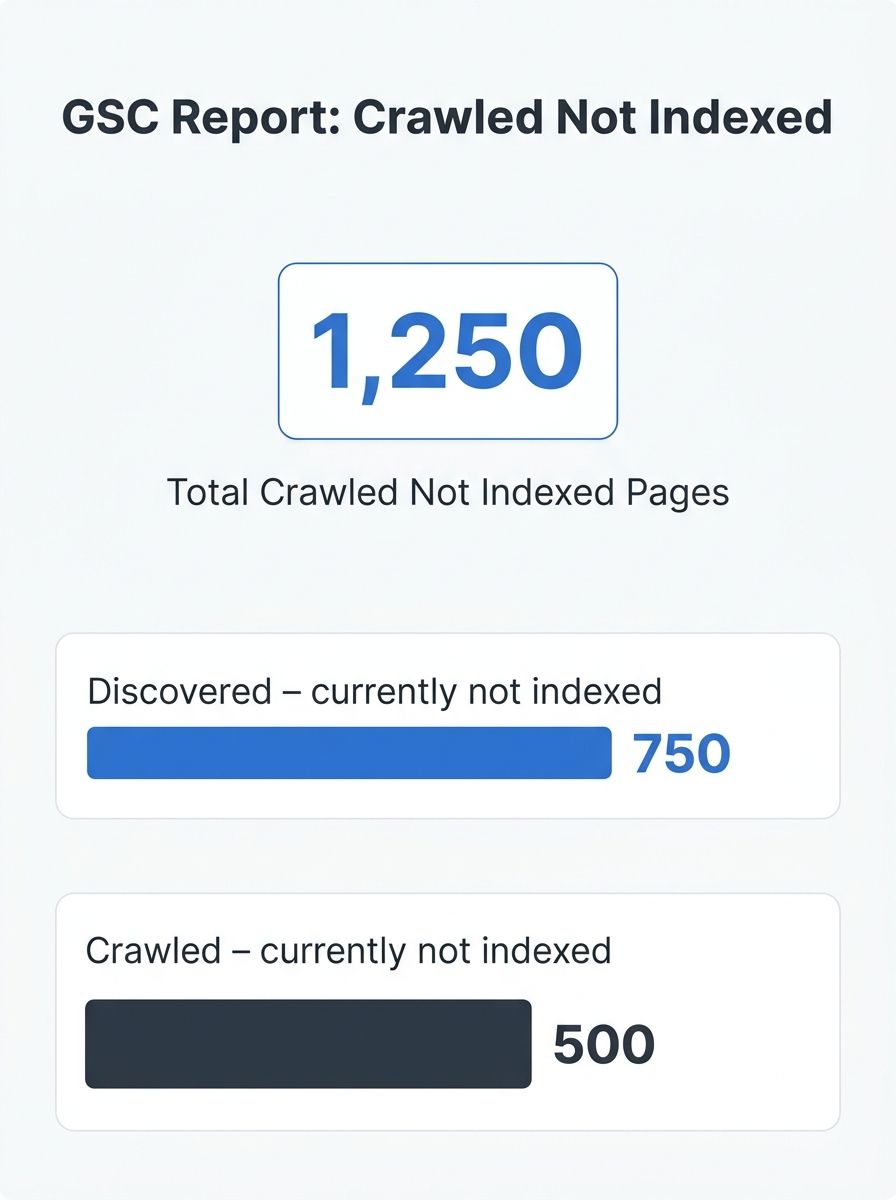
Google search engineers Martin Splitt and John Mueller explained on July 17 that the company's indexing systems reduce crawl frequency and page inclusion when algorithms detect site-wide quality concerns, according to a discussion published by Search Engine Journal. The officials stated that pages showing "crawled currently not indexed" status in Google Search Console's Page Indexing Report may reflect algorithmic quality assessments rather than technical configuration errors.
Quality Thresholds Trigger Indexing Reductions
Mueller stated that Google's systems "seriously worried about the quality of the website" will reduce indexed page counts as a resource allocation decision. "If we have strong concerns about the overall quality, then it doesn't make much sense for our systems to spend a lot of time on the website," Mueller said in the discussion. The search quality engineer confirmed this manifests as fewer pages crawled and indexed, with affected URLs appearing in Search Console's "crawled not indexed" or "discovered not indexed" categories.
The officials differentiated between two non-indexed states. Splitt explained that "discovered currently not indexed" indicates Google knows pages exist but has not visited them, while "crawled currently not indexed" means Google visited pages but chose not to include them in the index. Mueller confirmed the latter status sometimes signals quality assessment rather than technical problems.
User Behavior Patterns Surface in Quality Discussion
Mueller introduced visitor perception as a quality signal without explicitly confirming Google measures user behavior. "Taking a step back and trying to look at it with the eyes of someone who is not directly involved with your website, sometimes that opens up some ideas for areas where you can improve," Mueller said. He cited AI-generated content as a scenario where visitors "look at this AI generated site and they're like, well, I can tell this is AI generated, there's nothing unique or valuable that is available here for me."
The phrasing—"people look at this" rather than "our systems detect this"—leaves ambiguous whether Google's algorithms directly measure visitor assessments or infer quality from other signals. Mueller clarified that "not all AI-generated content is bad" but noted that generic material prompts visitors to conclude "anyone could have written this."
This connects to broader scaled AI content indexing patterns where mass-production strategies trigger crawl budget reductions.
Non-Technical Diagnosis Required When Technical Audits Fail
Mueller addressed site owners who attribute non-indexing to technical errors or negative SEO when quality assessment is the actual cause. "It's not so much that I would say you should take these situations and try to fix them from a technical point of view," Mueller said. He recommended stepping back to assess overall quality when "Google is not indexing a lot of your pages, and there's no technical reason."
The search engineer acknowledged the difficulty of self-assessment, noting "a lot of times, it's your website, and it's your baby. And of course, it's the best baby ever." Splitt confirmed that when sites are new, the Page Indexing Report shows progression through indexing stages, allowing webmasters to identify whether pages remain in "discovered" status or advance to "crawled" before exclusion decisions.
Mueller stated that once quality concerns resolve, Google's systems will "take another look and see if we can index it," but did not specify timeframes or thresholds for re-evaluation.
Reading Between the Lines
The July 17 discussion confirms what SEO agencies conducting technical audits have suspected: non-indexed pages with clean markup and proper robots.txt configurations may reflect algorithmic quality scoring rather than correctable technical defects. Mueller's reference to visitor perception—framed as what "people" conclude rather than what "our systems" detect—suggests Google may incorporate engagement or satisfaction signals into site-wide quality assessments, though the officials did not confirm specific metrics.
For agencies advising clients on indexing coverage gaps, this creates a diagnostic challenge. Standard technical SEO remediation—fixing crawl errors, adjusting internal linking, submitting sitemaps—will not resolve indexing suppression triggered by quality scoring. The discussion implies agencies need content audits focused on uniqueness, depth, and user value rather than exclusively technical validation when non-indexed page counts grow without corresponding technical issues.
The officials' framing of AI-generated content as a quality risk aligns with Google's March 2026 core update emphasis on information gain and originality. Sites producing content that visitors perceive as generic—whether AI-generated or human-written—face indexing headwinds that technical optimization cannot overcome.
Marcus Webb
Digital marketing consultant and agency review specialist. With 12 years in the SEO industry, Marcus has worked with agencies of all sizes and brings an insider perspective to agency evaluations and selection strategies.
Related Articles

Scaled AI Content Campaigns Face De-Indexation as Google's Crawl Budget Models Reject Mass-Production Strategies
Enterprise programmatic AI content initiatives are triggering manual penalties and de-indexation at scale as Google's crawl budget allocation models reject mass-produced pages that lack sustained user engagement signals, according to an analysis published by Search Engine Journal on July 14, 2026.

Google Publishes Official AI Search Guidance, Rejects Industry's GEO and AEO Optimization Frameworks
Google has published official documentation clarifying how its AI Overviews and AI Mode function, explicitly stating that "Generative Engine Optimization" and "Answer Engine Optimization" are not distinct practices from traditional SEO, according to guidance published on Cyber Kendra analyzing the 2

Google Extends Spam Update Rollout Window to Two Weeks as Search Console Adds Image-Search Filter
Google extended its spam update rollout window to two weeks for the September 2026 update launched September 24, marking a shift from the sub-three-day completion pattern of three prior 2026 updates, according to Search Engine Journal's weekly SEO update roundup.
Explore more topics