
Google Updates Canonicalization Guide With Two-Week Re-Evaluation Timeframe for Content Fixes
Google updated its canonicalization troubleshooting documentation on July 10, 2026 to specify that pages remain in duplicate clusters for up to two weeks after content corrections, according to Search Engine Journal.
 Marcus Webb··3 min read
Google Updates Canonicalization Guide With Two-Week Re-Evaluation Timeframe for Content Fixes
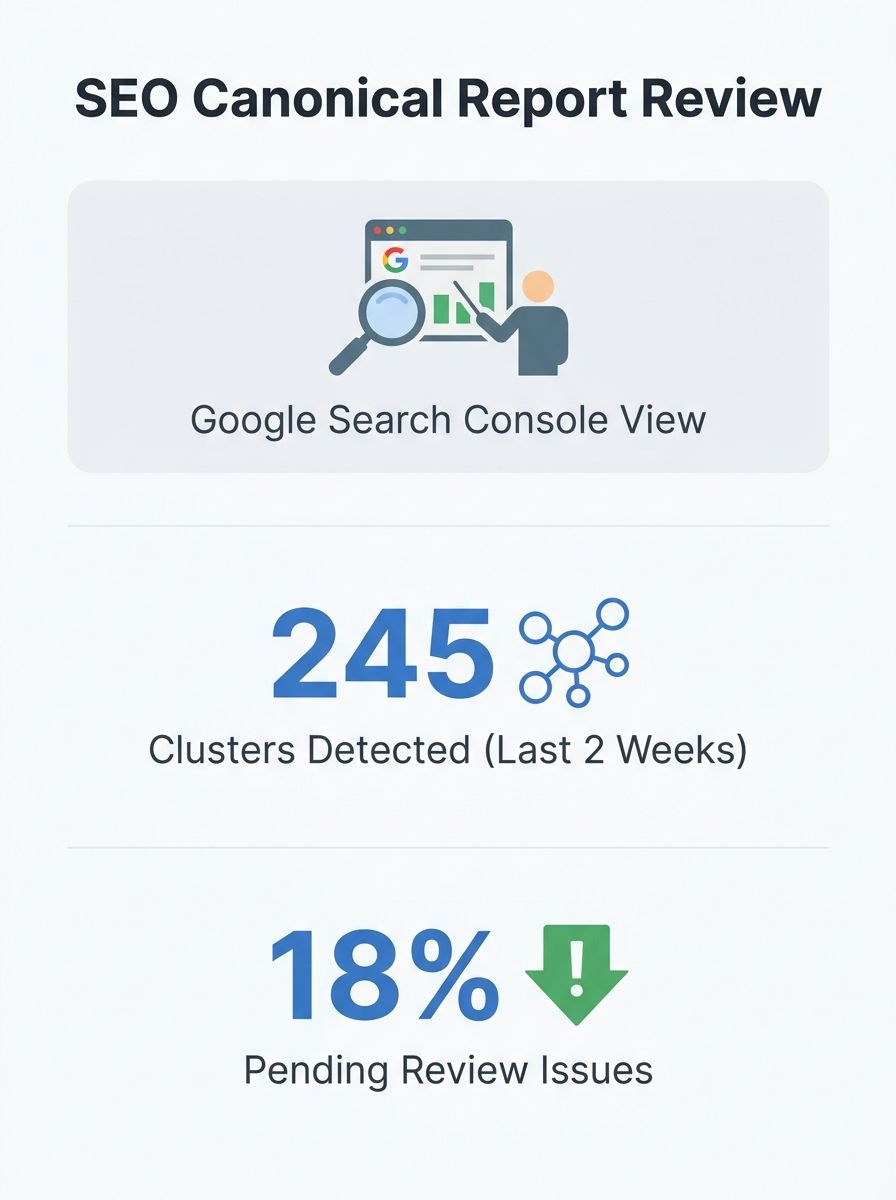
Google updated its canonicalization troubleshooting documentation on July 10, 2026 to specify that pages remain in duplicate clusters for up to two weeks after content corrections, according to Search Engine Journal. The new section addresses a timing question SEO practitioners have faced when diagnosing why Google-selected canonical URLs persist after implementing fixes. The guidance clarifies that the two-week window applies specifically to content differentiation fixes rather than technical corrections like redirect implementations or rel=canonical tag adjustments.
What the Two-Week Waiting Period Covers
The updated documentation applies the two-week timeframe exclusively to content-based canonicalization issues. Google groups pages into duplicate clusters when it identifies similar or identical main content across URLs, then selects one URL as the canonical version. The waiting period begins after site operators modify content to differentiate clustered pages sufficiently that Google no longer perceives them as duplicates.
The guidance distinguishes content fixes from other canonical signal corrections. Technical issues including 301 redirect configurations, rel=canonical tag errors, and server misconfigurations represent separate troubleshooting paths that fall outside the documented two-week window. Google's documentation treats these as distinct canonical problems requiring different resolution approaches.
The search engine recommends checking the Google-selected canonical URL through URL Inspection before beginning troubleshooting work. The documentation suggests evaluating whether Google's automated selection serves searchers better than the site operator's preferred canonical version.
How Content Distinctiveness Affects Re-Evaluation Speed
Pages can separate from duplicate clusters faster than the maximum two-week period when content differences become more pronounced. Google's documentation indicates the re-evaluation timeline operates on a spectrum, with the two-week figure representing the upper boundary rather than a fixed waiting period for all scenarios.
The guidance positions content differentiation quality as the primary variable affecting resolution speed. Substantial content modifications that create clear distinctions between previously-clustered pages trigger faster re-evaluation cycles. Minor content adjustments that leave pages marginally different result in longer waiting periods approaching the full two-week maximum.
Site operators can submit Request Indexing through Search Console after implementing content corrections to potentially accelerate the re-evaluation process. Google advises limiting this option to critical URLs rather than applying it broadly across all affected pages, consistent with the company's long-standing guidance on crawl resource allocation during technical implementations.
Implementation Context for SEO Teams
Google has revised canonical guidance multiple times in recent months. The company updated JavaScript documentation in early 2026 to address canonical tag injection methods after publishing broader canonical implementation advice for JavaScript-rendered sites. The July 10 update represents the latest refinement in an ongoing documentation expansion covering canonical signal handling.
The documentation update arrives as SEO teams face measurement challenges across multiple search interfaces. While traditional Google Search relies on canonical signals to consolidate duplicate content, the technical considerations differ from optimization principles that govern AI search results, where content consolidation operates through different algorithmic pathways.
The "Duplicate, Google chose a different canonical" status message in Search Console remains visible during the re-evaluation period even after site operators implement content corrections. The two-week guidance helps teams distinguish between fixes that haven't yet registered in Google's systems and corrections that failed to sufficiently differentiate the content.
The Takeaway
The documented two-week maximum for canonical re-evaluation provides SEO agencies with a specific timeframe for client communications when addressing duplicate content clustering. Practitioners can now set accurate expectations that content-based canonical fixes require patience beyond the typical indexing lag, preventing premature troubleshooting iterations that waste client budgets on redundant fixes.
The guidance creates a clear decision point: if the Google-selected canonical persists beyond two weeks after substantial content differentiation, the fix was insufficient rather than incomplete. That diagnostic clarity helps agencies avoid the common pattern of repeatedly tweaking content while waiting for signals to update, when the actual issue is that the content changes didn't create enough distinction for Google's clustering algorithm to separate the pages.
For agencies managing large client sites with canonical clustering across hundreds of URLs, the variance in resolution speed based on content distinctiveness suggests prioritizing the most differentiated content fixes first to demonstrate faster results, while setting longer timelines for pages where the business constraints limit how different the content can realistically become.
Marcus Webb
Digital marketing consultant and agency review specialist. With 12 years in the SEO industry, Marcus has worked with agencies of all sizes and brings an insider perspective to agency evaluations and selection strategies.
Related Articles
Google Extends Spam Update Rollout Window to Two Weeks as Search Console Adds Image-Search Filter
Google extended its spam update rollout window to two weeks for the September 2026 update launched September 24, marking a shift from the sub-three-day completion pattern of three prior 2026 updates, according to Search Engine Journal's weekly SEO update roundup.

Google's August 2026 Core Algorithm Update Shifts Rankings for 45% of Tracked Sites
Google's August 2026 core algorithm update caused ranking shifts for 45% of tracked websites while rewarding Core Web Vitals compliance with traffic gains between 12% and 28% and penalizing scaled AI content, according to SEO Vendor's recovery framework published August 8.

Google's March 2024 Core Update Penalized Topic-Cluster Content Strategies Brands Spent Three Years Building
Google's March 2024 Core Update eliminated approximately 40 percent of low-quality, unoriginal content from search results, according to Search Engine Journal, targeting the exact topic-cluster content strategies that mid-size and enterprise brands spent 2021 through 2024 building at scale. Many org
Explore more topics