
Model Swaps Now Define AI Search Volatility as Platforms Diverge Into Separate Ecosystems
Google replaced its AI Overviews model with Gemini 3 on January 27, 2026, without announcement, increasing cited sources per answer by roughly one-third and shifting visibility away from thinner websites toward entity-rich content, according to an analysis published by Yahoo Tech on August 10.
 Marcus Webb··4 min read
Model Swaps Now Define AI Search Volatility as Platforms Diverge Into Separate Ecosystems
Google replaced its AI Overviews model with Gemini 3 on January 27, 2026, without announcement, increasing cited sources per answer by roughly one-third and shifting visibility away from thinner websites toward entity-rich content, according to an analysis published by Yahoo Tech on August 10. The swap occurred independently of Google's core algorithm updates and left ChatGPT recommendations unchanged, illustrating a structural shift in how search visibility now changes.
Silent Model Swaps Replace Announced Algorithm Updates
The January 27 model upgrade carried no warning to site owners and produced no Search Console notification, yet reshaped which businesses appeared in AI-generated answers. Freshness signals gained weight, and citation counts per response rose approximately 33%, the analysis stated. ChatGPT, operating on a separate model pipeline, showed no corresponding change.
The analysis, which drew on client observation data, characterized model swaps as "unannounced, undocumented and arriving on multiple platforms at once." GPT-5.4's release later produced "noticeably increased volatility in AI recommendations across accounts," with constant reshuffling of which brands appeared in generated responses.
Gemini 3.5 Pro is expected to arrive before year-end alongside flagship model releases from other major labs, the piece projected. Modern AI search systems process single queries by fanning them into eight to twenty parallel sub-queries, retrieving sources for each and verifying claims before synthesis, the analysis explained. Research cited in the article shows only 25% to 33% of AI citations come from pages ranking in the traditional top ten search results.
Three Platforms Show 11% Citation Overlap
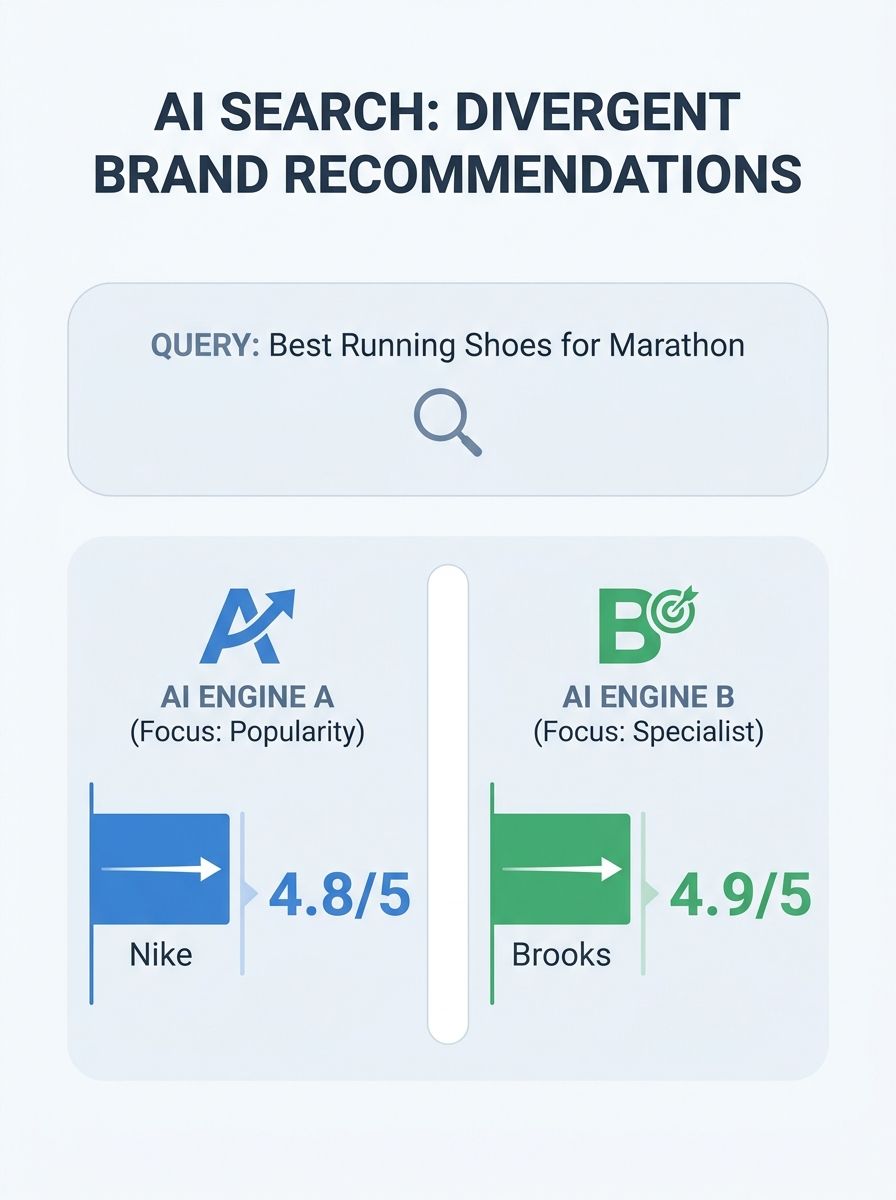
ChatGPT, Google Gemini, and Anthropic's Claude have diverged into fundamentally different competitive strategies, the analysis argued. A large-scale citation study referenced in the piece found that only 11% of domains are cited by both ChatGPT and Perplexity, and brand recommendations differ by 40% to 60% across platforms for identical queries.
ChatGPT is expanding its advertising pilot internationally to the United Kingdom, Mexico, Brazil, Japan, and South Korea while advancing personalization through memory features, according to the article. Gemini is integrating in-chat commerce allowing purchases without leaving the conversation. Claude has positioned itself as an ad-free professional tool, the analysis stated.
One dropshipping platform client was recommended heavily by Gemini yet vanished from certain ChatGPT recommendations despite previously ranking as ChatGPT's top pick two months earlier, the analysis recounted. When queried directly, ChatGPT explained the platform was not known for Shopify compatibility, even though the prompt never mentioned Shopify. After the client published content addressing Shopify integration, the platform reappeared in recommendations.
The analysis described current generative engine optimization work as "less about rankings, more about understanding, and correcting, what each model believes about you."
Personalization Builds Individual Recommendation Paths
ChatGPT, Gemini, and Claude are all building systems that remember individual users' preferences, history, and context, causing two people asking identical questions to receive different recommendations, the analysis noted. The piece previously argued that AI visibility operates as a "winner-takes-all game" because most users accept an assistant's initial recommendation rather than browsing alternatives.
The analysis recommended that businesses prepare for multiple visibility resets in the second half of 2026, advising content strategies centered on verifiable claims, named expertise, and consistent factual signals. Traditional Google algorithm updates followed documented patterns and advance warnings; model swaps occur across multiple platforms simultaneously with no public notice, the article stated.
Research showing citation behavior independent of traditional search rankings suggests businesses relying solely on Google SEO face exposure as AI platforms develop separate retrieval and recommendation logic, the analysis concluded.
Context and Outlook
AI search platforms' divergence into distinct ecosystems with minimal citation overlap places SEO agencies in a multi-front optimization environment where strategies must account for platform-specific ranking factors. The 11% overlap figure indicates that visibility in one AI engine provides limited predictive value for performance in another, requiring separate audits and content strategies for each platform. Agencies advising clients on AI search visibility should treat ChatGPT, Gemini, and Claude as independent channels rather than variations of a unified "AI search" category.
The shift from announced algorithm updates to silent model swaps removes the advance-warning cycle that allowed businesses to prepare for ranking changes. Google's August 2026 core algorithm update maintained the traditional announcement pattern, but model swaps within AI Overviews and AI Mode now operate on separate, undocumented schedules. Agencies need client-education frameworks explaining that AI visibility changes can occur without corresponding movements in traditional search rankings, requiring distinct monitoring and response protocols.
The analysis's recommendation to build content on verifiable claims and named expertise aligns with the Information Gain and GEO principles agencies are already implementing for traditional and AI search optimization strategies. However, the platform-divergence data suggests agencies should allocate testing budgets to measure performance independently across ChatGPT, Gemini, and Claude rather than assuming strategies optimized for one platform will transfer. The expanding ChatGPT advertising pilot introduces a new paid-visibility layer that may further differentiate platform strategies in the final quarter of 2026.
Marcus Webb
Digital marketing consultant and agency review specialist. With 12 years in the SEO industry, Marcus has worked with agencies of all sizes and brings an insider perspective to agency evaluations and selection strategies.
Related Articles
Five Major AI Search Engines Return Completely Different Answers to Identical Query in New Test
A technical developer testing five AI search engines with the same question received five distinct answers citing entirely different sources, according to a report published today on DEV Community. Google AI Overviews recommended GitHub Actions, ChatGPT suggested GitLab CI, Perplexity cited an unfam
Google Replaces Traditional Search with Gemini 3.5 Flash AI Model in Self-Described "Biggest Change in 25 Years"
Google replaced its traditional search results interface with AI-generated summary pages powered by the Gemini 3.5 Flash language model, the company announced June 20, 2026, calling the shift "the biggest change to Search in 25 years," according to the company's announcement. The new system replaces
AI Search Platforms Layer Atop Google Rather Than Replace It, Similarweb Tracking Shows
Ninety-five percent of ChatGPT's 494 million users also used Google during the March-May 2026 tracking period, according to Similarweb's "2026 Generative AI Landscape" report released July 24.
Explore more topics