
Small Local Businesses Hold Structural Search Advantage Over National Chains Through Proximity Signals
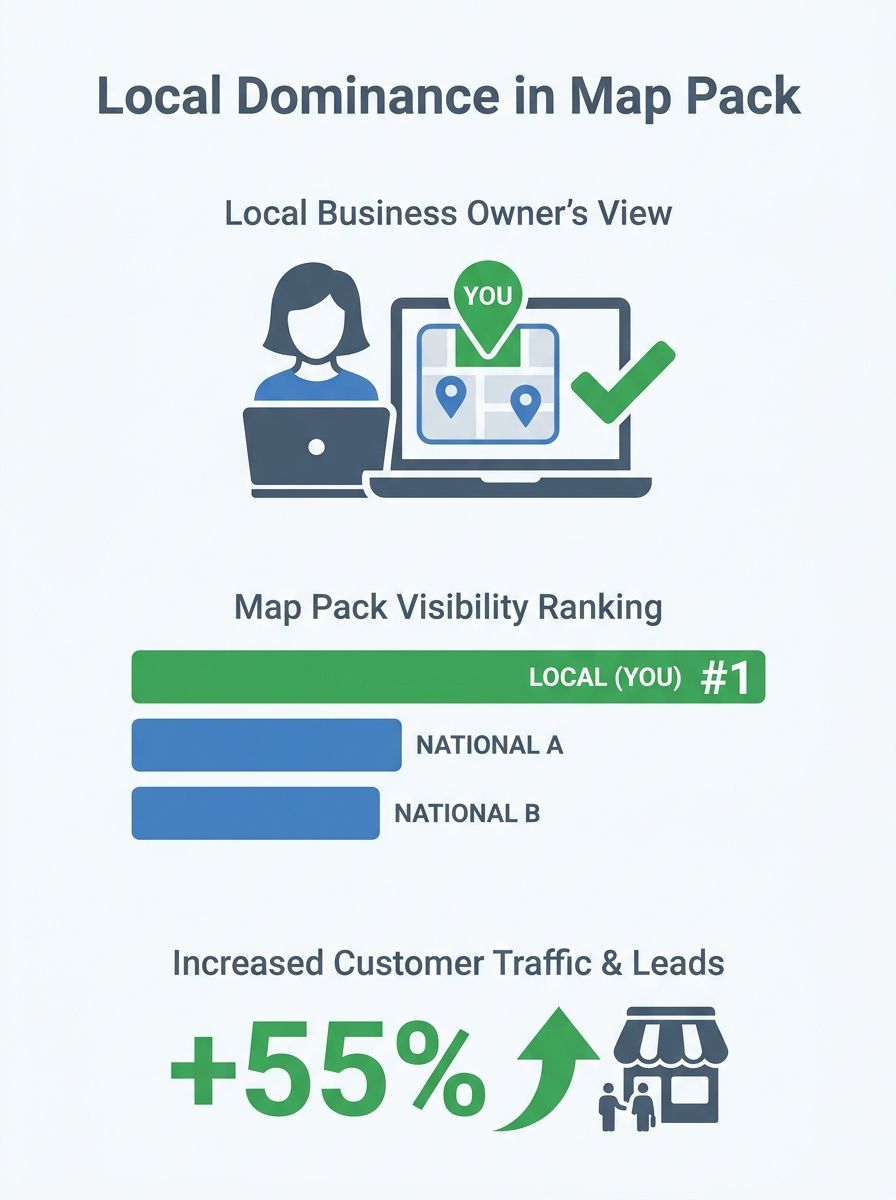
Proximity-based ranking factors give single-location businesses a structural advantage over national chains in local search results, allowing firms with complete Google Business Profile listings and recent reviews to outrank 900-branch competitors in map pack placements, according to an analysis pub
 Marcus Webb··3 min read
Small Local Businesses Hold Structural Search Advantage Over National Chains Through Proximity Signals
Proximity-based ranking factors give single-location businesses a structural advantage over national chains in local search results, allowing firms with complete Google Business Profile listings and recent reviews to outrank 900-branch competitors in map pack placements, according to an analysis published by Augusta Free Press on August 13.
Distance and Map Pack Rankings
Google's local results prioritize geographic proximity and query match over domain strength when determining which three businesses appear in the map block, according to the analysis. A single-location firm with a maintained listing and 40 recent reviews frequently outranks a chain with hundreds of branches because the chain competes across all markets without market-specific optimization.
National operators typically maintain one regional page covering multiple cities, the analysis found. The content remains generic to stay factually accurate across all covered locations, reducing its relevance for any specific search. A local business can reference specific streets, housing types, and completed projects within a defined service area, producing specificity search engines interpret as higher query relevance.
Proximity cannot be purchased or offset through other ranking signals, the publication noted. A franchise with its nearest location 14 miles from a searcher cannot appear in local results for that query regardless of marketing budget.
Technical Infrastructure Gaps
Page speed, uptime, and encryption function as ranking inputs where small businesses can close performance gaps through hosting decisions rather than sustained campaigns, according to the analysis. The difference between shared hosting and dedicated infrastructure typically produces load time improvements from 1.8 seconds to 400 milliseconds.
National brand websites often load slower than local competitors because corporate tracking scripts and legacy content management systems add overhead, the publication found. These technical choices create measurable performance disadvantages that budget cannot quickly reverse.
Long-Tail Query Opportunities
Specific search queries produce conversion rates that exceed head-term performance despite lower volume, according to the analysis. A page answering "cost of fitting carpet on stairs in a Victorian terrace" may attract 30 visits monthly but convert three into phone calls, producing a conversion rate national pages rarely match.
Head terms remain controlled by domains with years of accumulated link equity, the publication noted. Competing for "carpet fitting" requires link-building resources small businesses typically lack. The queries worth targeting are specific problems national copywriters cannot address without local knowledge.
This tactical focus aligns with strategies outlined by home services SEO agencies that prioritize location-specific content over generic service pages.
Review Management and AI Search Impact
Reviews function as the primary trust signal local businesses control directly, with steady flows of recent reviews outperforming larger volumes of older feedback, according to the analysis. Asking for reviews at job completion produces more responses than delayed email requests.
The analysis cited industry reporting showing 72% of local business owners received at least one fake review during 2026. Buyers now read three-star reviews first and evaluate response quality to critical feedback. Replying to negative reviews in plain language builds trust more effectively than accumulating additional positive reviews, the publication found.
AI-generated search summaries have shifted click-through patterns, with some content publishers losing over 70% of traffic according to coverage cited in the analysis. Service businesses experience lighter impact because AI summaries cannot complete transactions—the local map block appears above generated summaries in most service queries.
What This Means for Business Owners
Business owners competing against national chains should prioritize four tactics unavailable to larger competitors, based on the analysis: publishing actual project pricing, photographing completed work with recognizable local backgrounds, answering common customer questions using conversational language, and maintaining accurate listing details including holiday hours.
These actions require no approval processes and remain impossible for businesses managing hundreds of locations through templates. The competitive advantage stems from operational structure rather than budget.
Companies evaluating whether to handle local SEO internally or engage retail SEO agencies or hospitality SEO agencies should assess whether their team can execute location-specific content creation and listing maintenance consistently. The tactics themselves are straightforward, but sustained execution across multiple service areas becomes resource-intensive as business footprint expands.
Marcus Webb
Digital marketing consultant and agency review specialist. With 12 years in the SEO industry, Marcus has worked with agencies of all sizes and brings an insider perspective to agency evaluations and selection strategies.
Related Articles

Local SEO Guide Identifies Google Business Profile Optimization as Highest-ROI Tactic for Small Businesses in 2026
Success Knocks published a comprehensive local SEO strategy framework on May 21, identifying Google Business Profile optimization as the single highest return-on-investment tactic for small businesses competing in proximity-based search results, according to the analysis posted this morning. The gui

Search Engine Journal Updates Multi-Location SEO Framework for AI-Powered Search Era
Search Engine Journal published a revised multi-location SEO framework on June 9 that repositions Google's local ranking factors as entity-matching mechanisms rather than directory lookups, according to the guide authored by the publication's technical SEO team. The framework addresses how businesse

The Local SEO Setup Audit: Why Incomplete Google Business Profiles Cost Small Businesses Thousands in Lost Visibility
Roughly 86% of impressions on Google Business Profiles come from unbranded discovery searches — "plumber near me," "emergency dentist open Sunday" — according to Birdeye's 2026 analysis of local search behavior.
Explore more topics