
Google's August 2026 Core Algorithm Update Shifts Rankings for 45% of Tracked Sites
Google's August 2026 core algorithm update caused ranking shifts for 45% of tracked websites while rewarding Core Web Vitals compliance with traffic gains between 12% and 28% and penalizing scaled AI content, according to SEO Vendor's recovery framework published August 8.
 Marcus Webb··4 min read
Google's August 2026 Core Algorithm Update Shifts Rankings for 45% of Tracked Sites
Google's August 2026 core algorithm update caused ranking shifts for 45% of tracked websites while rewarding Core Web Vitals compliance with traffic gains between 12% and 28% and penalizing scaled AI content, according to SEO Vendor's recovery framework published August 8.
The broad core ranking recalibration hit affiliate sites hardest among major verticals, SEO Vendor's analysis shows. Pages with weak originality, thin evidence, or vague search intent experienced steeper drops than pages with clear value propositions and firsthand proof, the framework states.
Update Impact Across Site Categories
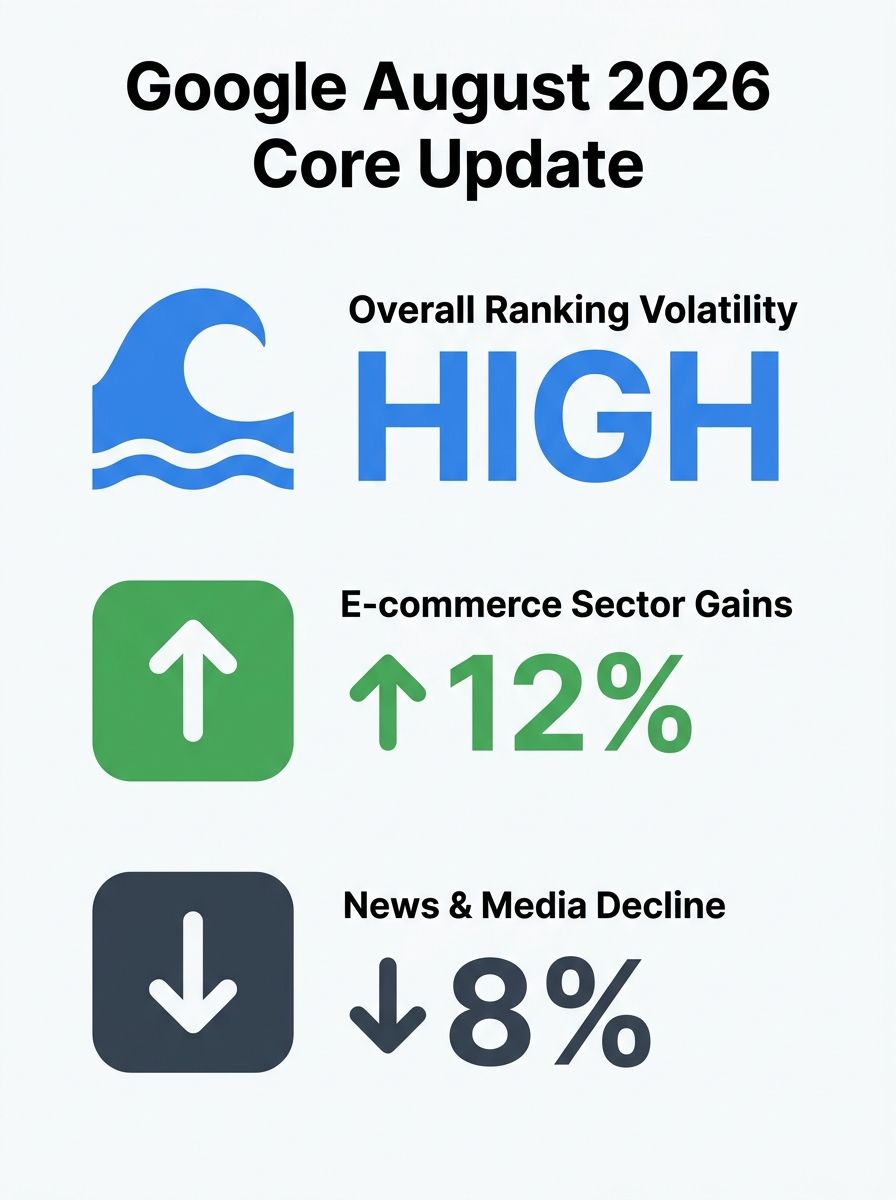
The August 2026 rollout affected 45% of tracked sites based on March 2026 baseline data, SEO Vendor reported. Sites maintaining strong Core Web Vitals scores gained between 12% and 28% more organic traffic during the update window, while properties using scaled AI content generation and expired domain strategies lost visibility, according to the framework.
Affiliate sites faced the highest impact rate among verticals tracked in prior core updates, with 71% experiencing ranking changes during the December 2025 core update. E-commerce properties saw a 52% impact rate and health sites reached 67% during the same period, the analysis shows. Top-three position churn reached 66.8% during December's rollout, SEO Vendor reported.
The volatility level varies across Google's core update timeline. March 2025 produced moderate volatility over 14 days, June 2025 brought high volatility across 17 days, and December 2025 delivered very high volatility over 18 days, according to the framework's historical comparison. The August 2025 spam update lasted 27 days, the longest recent rollout tracked.
Recovery Framework Components
SEO Vendor's diagnostic protocol starts with Google Search Console's Performance report, comparing the last 28 days against the prior 28-day period to identify URLs with the largest drops in clicks, impressions, and average position. The framework instructs site owners to sort by average position change and prioritize pages that fell from top-five positions to page two or lower, which signal more severe quality issues than minor single-position slides.
The recovery workflow requires waiting for the full rollout to complete before implementing broad site changes. "Google's June 2025 core update brought some sites partway back" during the rollout window, the framework states, indicating that early position losses may partially reverse as the algorithm stabilizes.
Content revision priorities target pages that lost rankings around a single search task, the framework states. Google referenced feedback from the 2023 Helpful Content Update when explaining the August 2024 core update's quality signals, SEO Vendor noted. The recovery protocol calls for merging or pruning thin pages chasing the same topic because they split ranking signals and blur page value.
Sites using automation, spam tactics, or stale claims across multiple pages face the highest recovery barriers. Google reported making 4,725 search algorithm changes in 2022 and 4,781 changes in 2023, leaving limited tolerance for weak pages in the index, according to the framework.
Historical Context From Prior Core Updates
The March 2024 core update cut low-quality content in search results by 45%, establishing the quality baseline that subsequent updates built upon, SEO Vendor's analysis shows. The June 2025 core update increased the weighting of Experience, Expertise, Authoritativeness, and Trustworthiness (E-E-A-T) signals, while the August 2025 spam update targeted link spam and manipulative content practices.
Query Deserves Freshness (QDF) factors increasingly influence which pages lose rankings during core updates, the framework states. Older pages covering topics where users expect current data, recent news, or new product releases slip in rankings even when content quality remains unchanged, SEO Vendor reported.
The framework identifies five common agency recovery mistakes: scope creep that blurs priorities, missing priority keyword drops, audit gaps that overlook crawl errors, overly broad content overhauls, and premature verdicts based on incomplete rollout data. Google Analytics, Google Search Console, SEMrush, and Core Web Vitals reports often show fluctuations requiring additional time before stable patterns emerge, according to the guide.
Sites ignoring algorithm update signals face compounding risks as subsequent updates build on prior quality recalibrations, SEO Vendor warned. The framework documents cases where delayed responses to one core update created larger ranking losses when the next update rolled out weeks or months later. Scaled AI content campaigns continue facing de-indexation as Google's crawl budget models reject mass-production strategies that dominated 2024 and early 2025.
Context and Outlook
The August 2026 core update arrives as Google's algorithm increasingly separates sites with genuine firsthand expertise from those relying on automated content generation or recycled information. Marketing managers and CMOs evaluating SEO agency performance should expect volatility to continue through the full rollout period, which may extend beyond the 14-to-18-day windows seen in March and June 2025 updates based on the 27-day August 2025 spam rollout.
Site owners should prioritize Search Console data over third-party tracking tools during the diagnosis phase because Google's Performance reports show actual search impression and click losses tied to specific queries and pages. Agencies promising immediate recovery often implement broad rewrites before the algorithm stabilizes, wasting client budgets on changes that may reverse as the update completes, the framework indicates.
The quality signals favoring Core Web Vitals performance and penalizing scaled AI abuse align with patterns established across 2024–2025 core updates, suggesting Google's ranking systems will continue rewarding technical performance and original expertise while devaluing automated content strategies. Sites maintaining strong page experience metrics and clear E-E-A-T signals through author bylines, cited sources, and firsthand testing typically recover faster from core update losses than properties relying on content volume alone.
Marcus Webb
Digital marketing consultant and agency review specialist. With 12 years in the SEO industry, Marcus has worked with agencies of all sizes and brings an insider perspective to agency evaluations and selection strategies.
Related Articles
QUASA Reports 50,000-Position Ranking Gain Following Google's Largest Core Update in 25 Years
QUASA reported a 50,000-position gain in Majestic's global website ranking and entry into the Top 150,000 sites worldwide following Google's May 2026 Core Update, which ran from May 21 to June 2 and triggered the largest search result volatility in more than 25 years, according to the company's inte
Google Confirms May 2026 Core Update Complete After 12-Day Rollout Marked by Multi-Phase Volatility
Google confirmed completion of its May 2026 core update on June 2 via the Search Status Dashboard, ending a 12-day rollout that began May 21 at 8:40 AM PDT and concluded June 2 at 5:40 AM PDT, according to Search Engine Journal. The update duration—11 days and 21 hours—nearly matched the March 2026
Google Launches June 2026 Spam Update Targeting Low-Quality Content Across All Languages
Google deployed a global spam-focused algorithm update on June 24, 2026, designed to reduce the visibility of websites violating the company's spam policies, according to an announcement from Advait Technology Labs. The June 2026 Spam Update applies across all languages and regions and is expected t
Explore more topics