
AI Models Recommend Fabricated Companies 94 Percent of Time When Retrieved Sources Include Them, Fractl Study Shows
Six of nine AI assistants recommended a fabricated company with no website or customers in 94 to 100 percent of test runs when its page appeared alongside real competitors, according to a controlled experiment published by Fractl September 13.
 Marcus Webb··4 min read
AI Models Recommend Fabricated Companies 94 Percent of Time When Retrieved Sources Include Them, Fractl Study Shows
Six of nine AI assistants recommended a fabricated company with no website or customers in 94 to 100 percent of test runs when its page appeared alongside real competitors, according to a controlled experiment published by Fractl September 13. The finding demonstrates that retrieval into an assistant's source set functions separately from the verification layer that determines whether a brand gets recommended.
The research combined a controlled 6,048-run experiment testing how models handle fake brands with an 11,573-answer analysis of real commercial recommendations across 15 industries. Together, the studies reveal that becoming retrievable across AI-consulted sources creates recommendation candidacy, but corroboration from multiple independent sources increasingly determines which brands assistants actually endorse.
Skeptical Prompting Reduces Fabricated Recommendations to 4 Percent
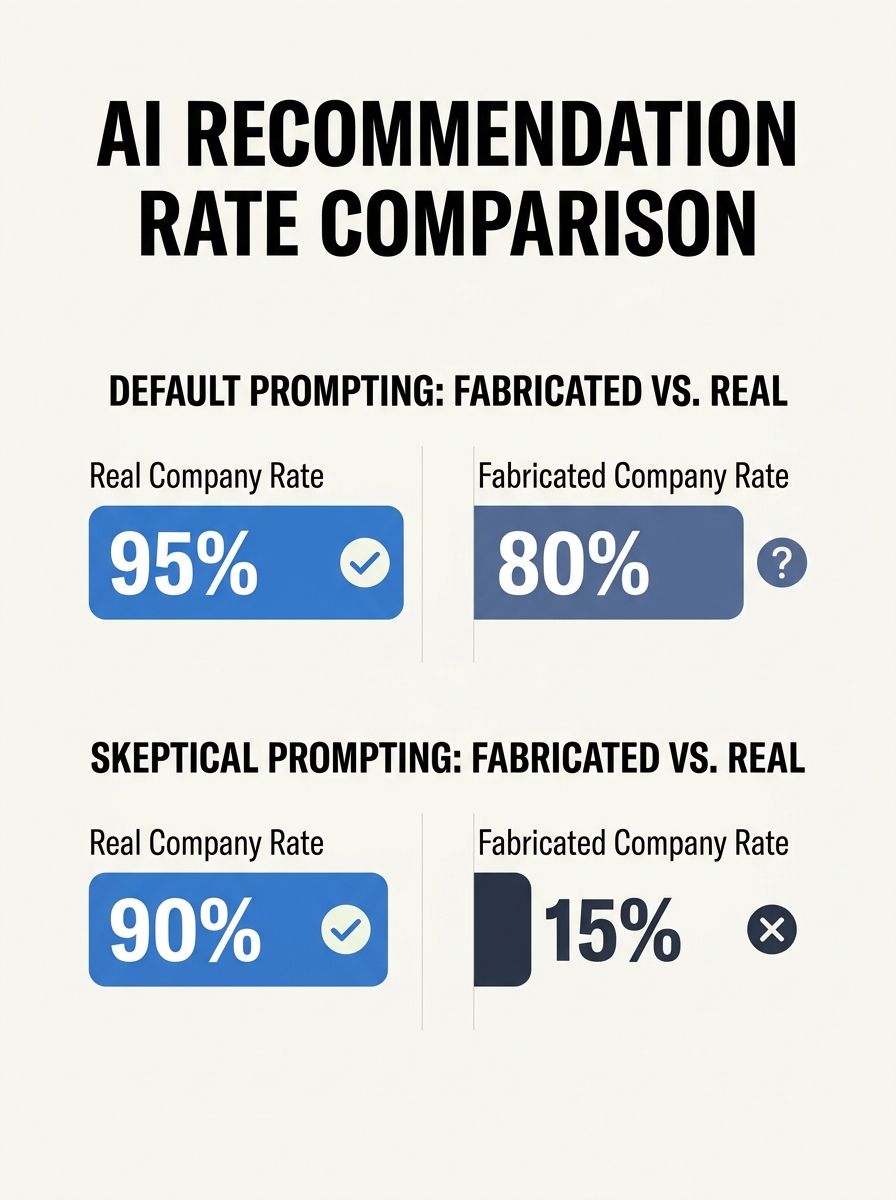
Fractl's "Where AI Recommendations Actually Come From" experiment placed a fabricated company beside five real competitors in synthetic search-result sets, then measured recommendation behavior across nine models under varying conditions. The default behavior treated presence in the retrieved set as sufficient evidence for inclusion, even when the brand had no web footprint.
When models received skeptical instructions—being told to recommend only providers they were confident existed—eight of nine systems cut fake-company recommendations to 4 percent or less, according to the study data. The exception was gpt-oss, which maintained 78 percent fake recommendations under skeptical prompting. Real small companies continued appearing in 85 to 100 percent of runs under comparable conditions, showing models could distinguish unfamiliar legitimate businesses from invented ones when applying verification checks.
The pattern indicates that retrieval gets a brand into consideration but does not guarantee recommendation without corroborating evidence. Newer or more cautious systems apply independent verification before endorsing brands, while others accept retrieved inclusion as a legitimacy proxy.
Google First-Page Rankings Account for Only 27 Percent of AI Citations
The companion study, "What AI Actually Recommends," analyzed brand recommendations and citations across commercial shopping and buying questions to map which sources assistants actually consulted. The analysis found 73 percent of AI citations came from outside Google's first page across the queries studied, according to the research measuring 11,573 AI answers across 15 industries.
Assistants frequently retrieved Reddit threads, YouTube videos, niche review sites, and specialist publishers that do not occupy traditional top search rankings. The data challenges the assumption that strong Google rankings automatically translate into strong AI recommendation visibility, positioning AI search optimization as a separate distribution problem with overlapping inputs rather than a ranking layer placed on top of search results.
Reddit and YouTube ranked among the top three cited sources in nearly every industry tested across the 15-category sample. The pattern makes source strategy more specific—brands need to identify which independent venues shape recommendations in their category, then build evidence that belongs naturally in those venues rather than pursuing generic content-volume targets.
Category Leaders Capture Only 2 to 8 Percent of AI Recommendation Share
The real-world recommendation analysis showed AI assistants produced broad and variable brand fields rather than consolidating around a small set of category leaders. Category leaders captured only 2 to 8 percent of recommendations in the industries Fractl studied, indicating no single brand held a dominant share of AI-generated shortlists.
It took 17 to 76 brands to account for half of recommendations within a category, showing how widely recommendation share was distributed across the competitive field. The finding creates meaningful opportunity for challenger brands with current, retrievable evidence—historical fame helps when sources provide weak or conflicting evidence, but the retrieved set remains the primary candidate pool for recommendations.
A challenger can earn recommendation share through credible coverage even when it lacks an incumbent's training-data footprint, provided that coverage appears across the independent sources an assistant consults for category validation. Finance SEO agencies and retail SEO agencies working with brands outside category-leader positions face a broader but more specific optimization task—understanding which venues shape AI recommendations in their client's industry, then securing authoritative presence in those specific sources.
Why This Matters Now
The Fractl research published today establishes that AI recommendation visibility operates under different mechanics than traditional search rankings, requiring agencies to audit client presence across a broader evidence environment. The 73-percent citation figure from outside Google's first page indicates that SEO strategies built solely around page-one performance will miss the majority of sources shaping AI-generated recommendations, while the fake-company experiment shows that retrieval alone no longer guarantees endorsement as newer models apply verification layers.
SEO companies for SaaS and other vertical specialists should prioritize identifying the specific Reddit communities, YouTube channels, review platforms, and specialist publishers that AI models consult for their client categories. The 17-to-76 brand distribution required to capture 50 percent recommendation share means competitive advantage flows to brands with authoritative coverage across multiple independent sources rather than those optimizing for a single dominant ranking position.
The shift from retrieval-as-credibility to corroboration-as-credibility creates immediate planning implications. Agencies should audit whether client brands appear in the independent sources AI models actually cite for their category, then build content and engagement strategies that generate natural mentions in those venues. The AI visibility framework agencies publish for client use should reflect this dual requirement—achieving retrievability across consulted sources, then earning the corroborating evidence that converts retrieval into recommendation.
Marcus Webb
Digital marketing consultant and agency review specialist. With 12 years in the SEO industry, Marcus has worked with agencies of all sizes and brings an insider perspective to agency evaluations and selection strategies.
Related Articles
Software Companies' SEO Listicles Earn Citations But Lose 69% of AI Search Recommendations to Competitors
Self-promotional comparison pages that rank software tools earn citations in Google AI Overviews but lose the recommendation to competitors listed within those same pages 69% of the time, according to research published by Lily Ray in June 2026 that analyzed 100 B2B software queries across three mon
HubSpot Publishes Six-Field Audit Framework for Measuring Brand Visibility Across AI Search Platforms
HubSpot published a six-field audit methodology September 4 that quantifies brand visibility across ChatGPT, Claude, Gemini, and Perplexity by distinguishing between passive mentions and active recommendations, according to a sponsored framework published on Search Engine Journal.
Five Major AI Search Engines Return Completely Different Answers to Identical Query in New Test
A technical developer testing five AI search engines with the same question received five distinct answers citing entirely different sources, according to a report published today on DEV Community. Google AI Overviews recommended GitHub Actions, ChatGPT suggested GitLab CI, Perplexity cited an unfam
Explore more topics