
SEO Tool Traffic Estimates Run 7 to 9 Times Higher Than Google Search Console Data in Side-by-Side Testing
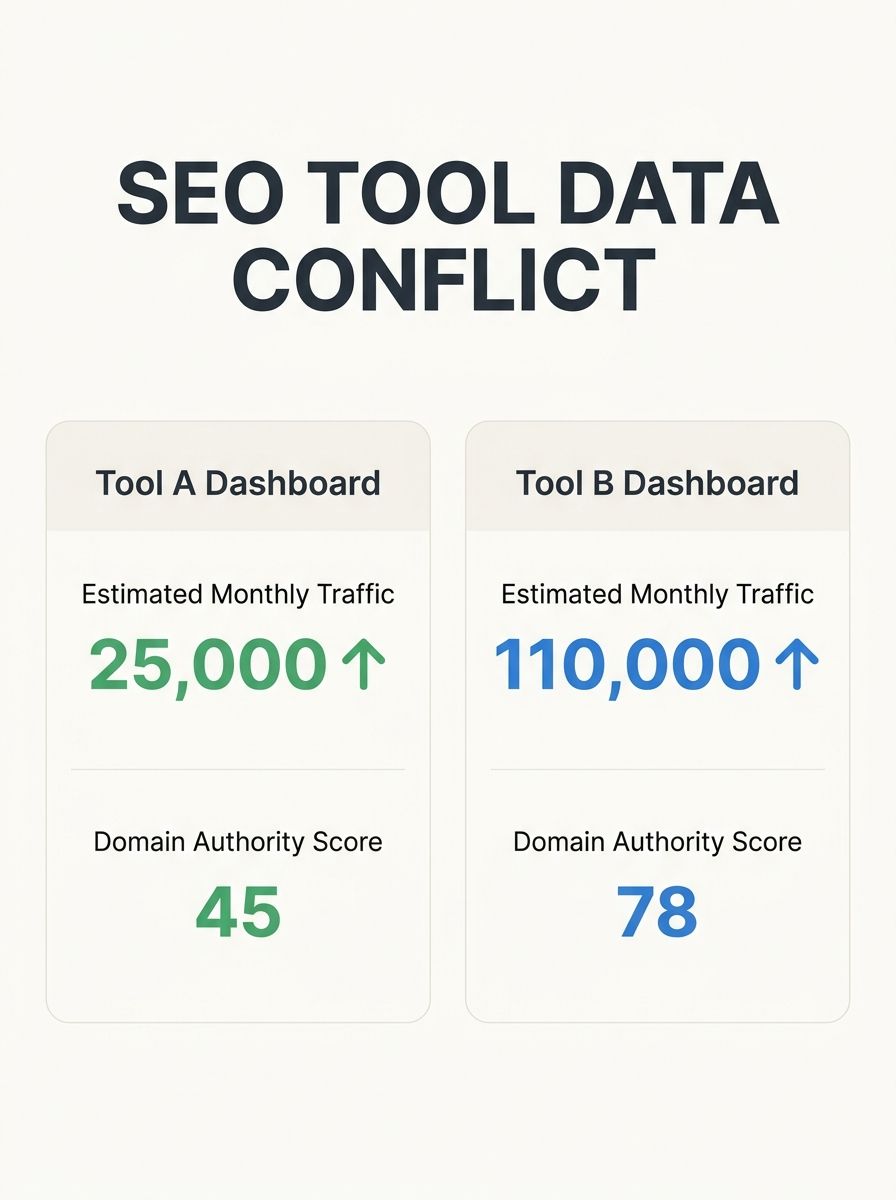
Ahrefs and Semrush traffic estimates exceeded actual Google Search Console clicks by 7.1 and 9.2 times respectively when tested on the same domain during the same measurement period, according to a six-test analysis published September 25 by Arfadia, an Indonesian SEO agency.
 Marcus Webb··4 min read
SEO Tool Traffic Estimates Run 7 to 9 Times Higher Than Google Search Console Data in Side-by-Side Testing
Ahrefs and Semrush traffic estimates exceeded actual Google Search Console clicks by 7.1 and 9.2 times respectively when tested on the same domain during the same measurement period, according to a six-test analysis published September 25 by Arfadia, an Indonesian SEO agency. The tests, conducted September 21-25 across four domains in two countries, found disagreement on every core metric including authority scores, backlink counts, and keyword volume estimates.
Tessar Napitupulu, founder and CEO of Arfadia and member of the Forbes Agency Council, led the testing across Ahrefs, Semrush, and Moz. The research addressed what Napitupulu described as a persistent gap in SEO tool reviews: "Most 'best SEO tools' articles are feature tours," the report states. "They list what each platform can do, paste in the pricing, and call it a review. Almost none of them check whether the numbers those platforms produce are actually right."
The discrepancies extended beyond traffic estimates. Authority scores for the same domain varied by up to 35 points on a 100-point scale across the three platforms, and each tool ranked its own domain highest in backlink counts. On one Australian keyword, volume estimates disagreed by at least 500 times between platforms.
Testing Methodology and Scope
The analysis covered six distinct tests: traffic estimates verified against Search Console data, authority score comparisons across four domains, backlink count variations, keyword volume disagreements in US and Australian markets, site crawl accuracy, and AI assistant recommendations. All measurements were timestamped to September 21-25, 2026, allowing for direct reproduction.
In the traffic estimate test, Ahrefs reported 7.1 times the clicks that Google Search Console recorded for the same domain and timeframe, while Semrush's estimate ran 9.2 times higher. The report notes both platforms' figures were checked against Search Console as "the one tool on this list that reports what Google itself recorded: real clicks, real impressions, the real queries your pages showed up for."
The four domains tested ranged from a small site where Ahrefs found 6,200 referring domains to larger properties including ahrefs.com, semrush.com, and moz.com themselves. On the smaller domain, Ahrefs detected the most referring domains at 6,200, compared to Semrush's 4,600 and Moz's 3,400. On the three established platform domains, the pattern reversed.
Authority Score Discrepancies Reach 35 Points
Authority metrics showed systematic disagreement across platforms. Semrush assigned the lowest authority score to three of the four domains tested, including a score of 65 for moz.com where both Ahrefs and Moz's own Domain Authority metric reported 91. The 26-point spread on a single domain exceeded what Napitupulu characterized as acceptable variance for a standardized metric.
The backlink count test revealed what the report termed a "self-preference pattern": each tool ranked its own domain first in referring domain counts. The report states this finding matter-of-factly without ascribing intent, noting only that "each tool ranked its own domain first."
Keyword volume estimates produced the widest disagreement. One Australian keyword showed at least a 500-times difference between platforms' monthly search volume figures. The report tested ten keywords split between US and Australian markets.
Site Crawl and AI Recommendation Results
Three crawlers run on the same site found 1, 0, and 28 broken pages respectively. Screaming Frog's desktop crawler reached the highest URL count at 5,461 pages, though the report notes that Semrush and Moz tests ran on free-tier accounts with documented crawl caps. Ahrefs hit its monthly crawl credit ceiling during testing, leaving 47,694 discovered links uncrawled until the billing reset.
AI assistant recommendations showed the strongest consensus of any test. Semrush appeared as the top recommendation in 28 of 30 responses collected from five AI platforms, including ChatGPT, Perplexity, Claude, Gemini, and an unnamed fifth assistant. The report documented all 30 query-and-response pairs with timestamps.
The analysis follows a broader pattern of measurement discrepancies documented across SEO intelligence tools, where overlapping product categories use incompatible underlying metrics. Similar discrepancies emerged in backlink checker comparisons showing 100 percent variation across platforms for identical sites.
Pricing checked September 25 shows Ahrefs Lite at $129 monthly for five projects and 750 tracked keywords, Semrush's SEO plan at $139 monthly for five websites and 500 keywords, and Moz Standard at $249 monthly for five campaigns. All three platforms offer free tiers with significant feature restrictions.
Why This Matters Now
Business owners and marketing managers selecting SEO tools face a metric reliability problem that standard vendor comparisons don't surface. When traffic estimates run 7 to 9 times higher than verified Google data, the error compounds through reporting chains: agencies present inflated projections to clients, marketing teams allocate budget based on inflated opportunity sizing, and performance benchmarks drift away from achievable outcomes. The September 2026 testing provides the first publicly timestamped side-by-side verification against Google Search Console for tools holding dominant market share.
The practical recommendation emerging from the tests—Google Search Console as the measurement baseline, supplemented by one paid platform chosen for a specific capability gap—shifts tool selection from feature breadth to workflow fit. Agencies focused on link prospecting and competitor analysis may prioritize Ahrefs' referring domain index; teams running integrated SEO and PPC campaigns gain efficiency from Semrush's combined reporting; and technical audits requiring live crawls justify Screaming Frog's desktop architecture despite its lack of competitor data. The sequential testing across the same domains in the same week eliminates temporal variance as an explanation for the discrepancies.
For CMOs evaluating agency reports, the findings create a verification requirement: any traffic forecast, authority score, or backlink count drawn from a third-party platform should either include a dated Search Console comparison or carry an explicit "modeled estimate" label. The 500-times keyword volume disagreement documented in the Australian market test shows that geographic databases compound the underlying index differences, making international campaigns particularly vulnerable to forecast error.
Marcus Webb
Digital marketing consultant and agency review specialist. With 12 years in the SEO industry, Marcus has worked with agencies of all sizes and brings an insider perspective to agency evaluations and selection strategies.
Related Articles
Backlink Checker Discrepancies Reach 100 Percent Across Platforms for Identical Sites, Analysis Shows
Backlink analysis tools routinely miss one-third of indexed links, display authority scores Google has confirmed it does not use, and can disagree by up to 100 percent on referring domain counts for identical sites checked simultaneously, according to a September 7 analysis published by marketing co
SEO Tools Analysis Identifies 20 Leading SERP Tracking and Website Audit Platforms for 2026 Budget Tiers
TechyFlavors published a comprehensive analysis of 20 leading SEO tools on May 21, identifying the top SERP tracking and website audit platforms for 2026 across free and premium price tiers, according to the evaluation posted on the digital marketing publication's website.
Ahrefs Leads SEO Platform Database Capacity as Adobe-Owned Semrush and Budget-Focused Serpstat Serve Distinct Market Segments
Ahrefs maintains the largest backlink database among leading SEO platforms with 35 trillion live links and 16 years of historical data, according to a comprehensive tool comparison published August 29 by TheNextHint.
Explore more topics