
Law Firm SEO Performance Framework Emphasizes Client Acquisition Cost Over Rankings
Law firms should measure SEO performance by signed client acquisition cost and attributed revenue rather than keyword rankings and traffic volume, according to a strategic analysis published October 1 by Finance Monthly that connects organic search investment with legal matter economics.
 Marcus Webb··4 min read
Law Firm SEO Performance Framework Emphasizes Client Acquisition Cost Over Rankings
Law firms should measure SEO performance by signed client acquisition cost and attributed revenue rather than keyword rankings and traffic volume, according to a strategic analysis published October 1 by Finance Monthly that connects organic search investment with legal matter economics.
Framework Shifts Focus From Traffic Metrics to Matter Economics
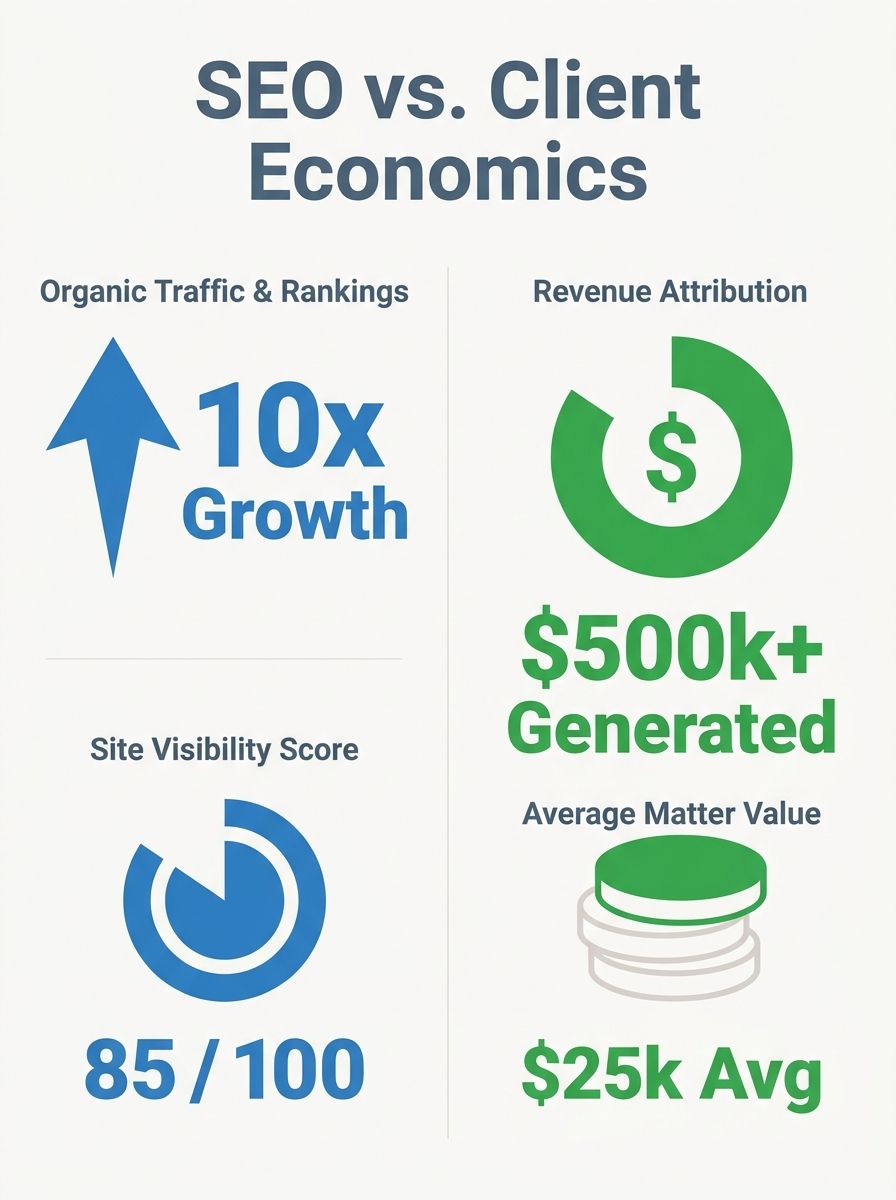
The framework positions organic search as a client-acquisition channel requiring the same financial discipline firms apply to paid advertising, referral arrangements, and sponsorships. A law firm spending $15,000 monthly on SEO cannot assess performance simply because traffic increased, according to the analysis—it needs to track how many visitors became legitimate inquiries, how many matched practice areas and geographic footprint, how many scheduled consultations, and what expected or realized value those matters represented.
Clio's 2025 Legal Trends Report found that websites and referrals remained among the most widely used marketing channels while SEO investment held steady even as spending on traditional and paid advertising declined, the analysis noted. That allocation pattern makes measurement more urgent: firms need to know whether organic search produces economically valuable matters at acceptable acquisition costs.
The framework distinguishes between operating metrics—keyword positions, impressions, organic sessions, backlinks—and financial outcomes. None of the traditional SEO metrics tells management whether the investment produces profitable legal work, according to the methodology.
Cost Per Lead Metrics Can Obscure Poor Matter Economics
Even cost-per-lead measurement can produce misleading conclusions when inquiry volume does not translate to signed matters or revenue, the framework shows. Two practice areas each generating 100 inquiries can produce vastly different economics: one may attract high volumes of prospects the firm cannot represent because of jurisdiction, case quality, or conflicts, while another generates fewer signed clients but matters with substantially stronger contribution margins.
The economic value of a legal client varies dramatically by practice area—traffic-ticket matters, corporate transactions, and catastrophic injury claims operate on completely different revenue models, sales cycles, and servicing costs, according to the analysis. A meaningful SEO dashboard therefore requires metrics including cost per qualified inquiry, cost per signed matter, and revenue attributable to organically acquired clients.
Those figures enable comparison of organic acquisition with paid media and referral arrangements on a consistent financial basis, the framework states.
Organic Search Operates on Different Cash-Flow Timeline Than Paid Channels
SEO and paid advertising behave differently financially, creating evaluation challenges when firms compare channels directly. Paid search produces demand quickly but traffic generally stops when spending stops, while organic visibility requires longer build periods—technical improvements, local search optimization, content development, and authority signals may take months before generating material pipeline, according to the methodology.
Once established, successful pages continue generating discovery without separate media charges per click. That does not make organic traffic "free," the analysis notes—firms still incur agency fees, salaries, content costs, technology expenses, and management time—but the cash-flow profile differs from paid acquisition.
The financial question becomes payback period. A new practice-area section may produce little revenue during initial months while development costs accumulate, but if it subsequently generates qualified cases for several years, evaluating only the launch-period return understates economic contribution. Conversely, historical rankings should not justify indefinite spending on pages that no longer generate commercially relevant demand, the framework states.
AI Search Integration Adds Attribution Complexity
Google's addition of generative-AI performance reporting in Search Console creates new measurement requirements. The company announced dedicated AI Overviews reporting in June 2026 and rolled out those insights to websites by August 31, according to the analysis. AI search systems now increasingly answer questions within Google's own experience rather than sending clicks to websites, changing the traditional relationship between impressions, rankings, and traffic.
That shift makes connecting SEO activity to financial outcomes more complex but also more important, the framework argues. Firms need attribution systems tracking which content appears in AI-generated responses, whether those appearances correlate with inquiry volume, and how AI-driven discovery compares economically to traditional organic results.
The framework recommends law firm SEO companies implement tracking connecting Search Console AI performance data with CRM inquiry records and matter management systems to measure AI search contribution to client acquisition costs.
Why This Matters Now
Law firms evaluating SEO agency performance face a gap between traditional reporting and financial accountability. Most SEO dashboards emphasize rankings, traffic, and backlink counts—diagnostic measures that don't answer whether organic search delivers clients at acceptable acquisition costs. This framework provides CMOs and managing partners with a structure for connecting SEO spending directly to signed matters and revenue attribution.
The methodology becomes especially relevant as AI search reduces traditional website traffic while potentially maintaining or increasing inquiry volume through AI Overview appearances. Firms need measurement systems that capture value regardless of whether prospects reach the website or contact the firm after seeing information in AI-generated responses. Attribution must extend beyond last-click models to account for organic search's role across longer consideration cycles typical in legal services.
Business owners and marketing managers evaluating agency proposals should require reporting on cost per qualified inquiry, cost per signed matter, and revenue attribution by practice area. Agencies that cannot connect their SEO work to these financial outcomes are optimizing for visibility metrics that may not translate to profitable client acquisition.
Marcus Webb
Digital marketing consultant and agency review specialist. With 12 years in the SEO industry, Marcus has worked with agencies of all sizes and brings an insider perspective to agency evaluations and selection strategies.
Related Articles

How Law Firms Are Rebuilding Rankings in the Dual-Search Era: AI Overviews vs. Traditional Google Results Strategy
The dual-search strategy that SEO agencies are packaging for law firms contains a structural contradiction.

Organic Traffic Declines Persist Despite SEO Improvements, LeadRaft Marketing Framework Shows
Organic traffic can decline even when SEO metrics improve, according to a diagnostic framework published September 19 by LeadRaft Marketing that identifies seven distinct factors causing visitor drops independent of optimization quality.

SEO Agency Excell Industries Publishes 2026 Trends Framework Emphasizing AI-Powered Search and Core Web Vitals
Digital marketing agency Excell Industries published an SEO trends framework on August 21 identifying AI-powered search optimization, user intent alignment, and Core Web Vitals performance as dominant ranking factors heading into the second half of 2026, according to a guide posted to the firm's web
Explore more topics