
Google Deploys Hotel Tracking, Trip Planning, and Store-Calling Features as Search Shifts to Task Execution
Hotel price tracking at the property level, automated trip itineraries, and AI-powered store inventory calls now operate within Google Search, according to updates the company released April 25. The three features push more of what used to be a results-page experience into direct task completion, Se
 Marcus Webb··4 min read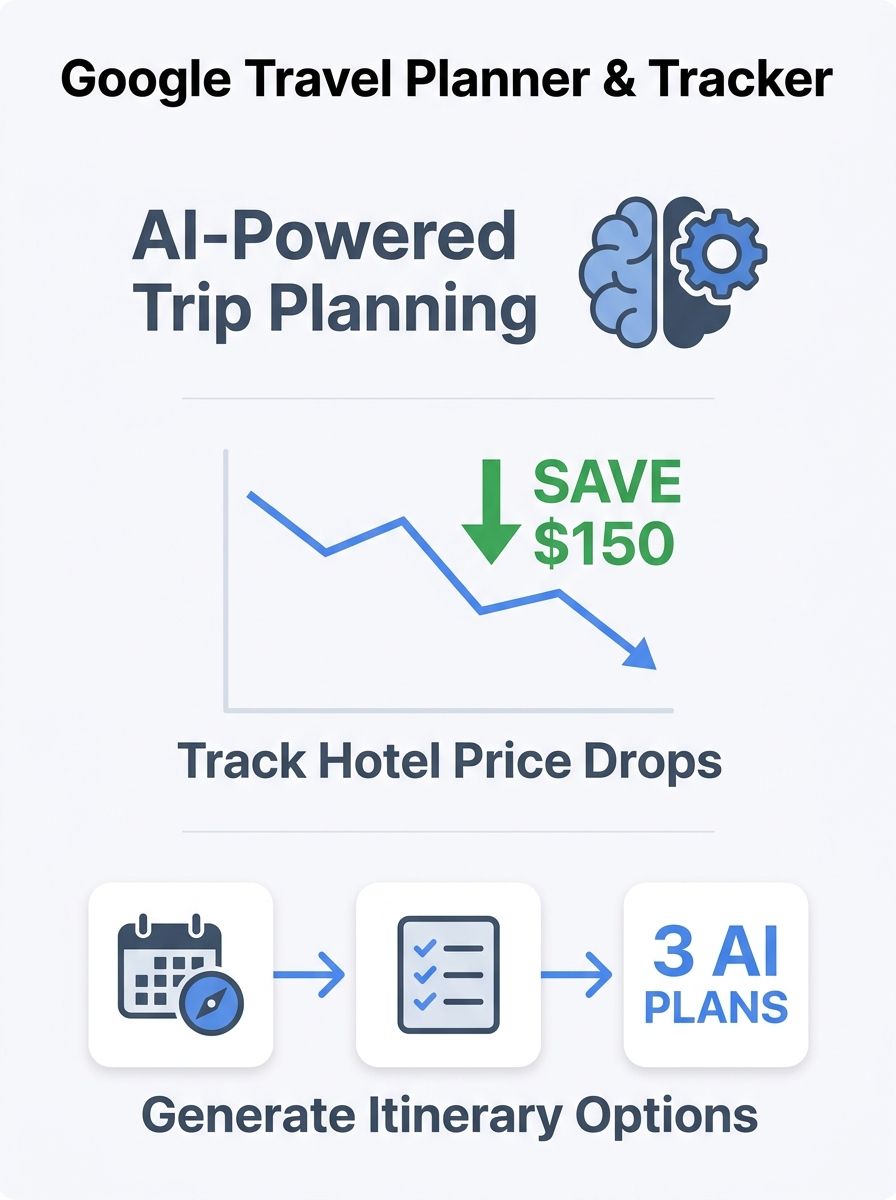
Google Deploys Hotel Tracking, Trip Planning, and Store-Calling Features as Search Shifts to Task Execution
Hotel price tracking at the property level, automated trip itineraries, and AI-powered store inventory calls now operate within Google Search, according to updates the company released April 25. The three features push more of what used to be a results-page experience into direct task completion, Search Engine Journal reported.
Google launched individual hotel price tracking globally for signed-in users searching in English and Spanish, sending email alerts when rates change during selected dates. Canvas trip planning in AI Mode moved from Labs preview to general U.S. availability in March, allowing users to describe trips and receive custom itineraries with flights, hotels, and attractions that save automatically. Agent-powered store calling, first introduced in classic Search, will soon roll out to AI Mode, enabling Google's AI to call nearby stores and check inventory using Gemini models and Duplex, according to a blog post from Rose Yao, Product Leader in Search.
The updates reflect Google's product direction seen in research, patents, and executive statements since January, the report noted. In January, Google published the SAGE research paper on training agents for reasoning chains over four steps. CEO Sundar Pichai said in an April interview that "a lot of what are just information-seeking queries will be agentic in Search."
Features Moving From Preview to Production
Canvas trip planning launched in November and reached broader U.S. availability approximately five months later. Store calling debuted in Search last November before its planned AI Mode expansion. Hotel price tracking now operates at the single-property level rather than aggregated results.
Microsoft announced similar moves this week. Sumit Chauhan, President of Microsoft's Office Product Group, wrote in a company blog post that Copilot's agentic capabilities are now generally available in Word, Excel, and PowerPoint. "Copilot creates the most value when it performs the work—formatting, restructuring, building visuals, and transforming data—rather than just suggesting steps," Chauhan stated. The features are default for Microsoft 365 Copilot and Premium subscribers, and available to Personal and Family plans.
A U.S. Patent Office filing published last week described a Google system titled "Autonomously providing search results post-facto" that waits for answers when none are immediately available, then delivers them later through assistant interactions. The filing supports the pattern of search moving from instant results display to delayed task completion.
Terminology Remains Unsettled
Google uses "agentic" in its product language and announcements, describing features like calling and AI Mode as task-oriented. A SeatGeek partnership was labeled "Google's Agentic AI Search Experience." Pichai describes "agent manager" as Google's role, positioning the company as an orchestration layer overseeing various tasks rather than a direct competitor to other agents.
Search Engine Journal reporter Roger Montti has used "task-based agentic search" in recent coverage, sometimes shortened to TBAS as shorthand for this coverage area, though this is not industry-standard terminology. When three different labels appear in one month, the market is still determining naming conventions.
Visibility Gaps Emerge Across Business Categories
Local retailers now encounter a discovery surface where Google's agents, rather than users, will contact businesses to verify stock and details. Google has not disclosed which stores its agents will contact first, how eligibility is decided, or if specific business information influences the process, according to the report.
An analysis of 68 million AI crawler visits across 858,457 Duda-hosted sites shows that sites with connections to Yext, Google Business Profile, and review systems were crawled more often than those without. These findings describe crawler behavior, not agent calls. Whether similar signals influence which stores receive agent contact remains unknown.
Hotels and travel businesses now face individual-property price monitoring and trip itineraries based on Canvas selection logic. No reporting shows if a hotel appeared in a Canvas plan, triggered an alert, or was named in an AI Mode response.
Publishers face continued pressure from AI-driven summarization. Index Exchange analyzed 1,200 publishers on its exchange platform, finding that 69% experienced year-over-year declines in ad opportunities, with an average drop of 14%. Declines varied across verticals, with health and careers publishers seeing 40-50% ad drops, while news and politics publishers saw only 7% declines.
Services Implications
SEO agencies advising enterprise clients must now account for task-completion surfaces that operate outside traditional ranking metrics. When Google's AI calls stores or generates trip itineraries, businesses receive no visibility into whether they were considered, selected, or excluded. Agencies lack the reporting infrastructure to measure performance on these surfaces, creating a gap between what optimization strategies target and what actually drives customer acquisition.
For local retail clients, ensuring Google Business Profile completeness and establishing connections to structured data platforms like Yext may influence agent selection patterns, based on observed crawler behavior. However, without confirmation from Google about agent selection criteria, agencies are optimizing against incomplete signals. Hotel and travel clients require new monitoring approaches for Canvas trip planning visibility, as traditional position tracking does not capture inclusion in AI-generated itineraries or price alert triggers.
Enterprise clients operating in health, careers, or publisher verticals face the most immediate revenue pressure from task-completion features that reduce traditional search traffic. Agencies must develop alternative traffic acquisition strategies and revenue attribution models that account for declining ad opportunities from organic search, while simultaneously positioning clients for visibility in the emerging task-based surfaces where measurement remains unavailable.
Marcus Webb
Digital marketing consultant and agency review specialist. With 12 years in the SEO industry, Marcus has worked with agencies of all sizes and brings an insider perspective to agency evaluations and selection strategies.
Explore more topics